
Let’s make this make sense. Few feeding questions create as much quiet tension for cat owners as the choice between wet food and dry food. One side emphasizes moisture and closer-to-prey texture. The other emphasizes convenience, dental claims, and cost control. Both sides can sound convincing. Neither side fits every household or every cat.
I’m Claire Whitaker. For more than ten years I worked as a client educator in small-animal clinics around Minneapolis, helping owners sort through everyday feeding decisions. My job was not to declare a single winner. It was to help people look at the actual trade-offs—hydration, calories, cost, schedule, and how the individual cat responded—so the choice felt steadier and less driven by online pressure.
This post is the slower version of those conversations. We will compare the practical strengths and limits of each format, look at the claims that often create confusion, and outline a calm way to decide or combine the two without turning mealtime into a source of guilt.
Why the Debate Feels Louder Than It Needs To
Cats evolved as animals that obtained much of their water from prey. That biological background is real and useful to remember. It does not automatically mean that every dry-fed cat is dehydrated or that every wet-fed cat is optimally hydrated. Modern commercial foods, household water access, and individual drinking habits all sit between the evolutionary starting point and the bowl in your kitchen.
In clinic conversations I noticed that owners often arrived already feeling they had chosen “wrong.” Someone had told them dry food was dangerous for kidneys. Someone else had told them wet food was messy, expensive, and bad for teeth. The resulting anxiety was frequently higher than the actual risk for a generally healthy cat on a complete diet.
A more useful starting point is to treat both formats as tools rather than moral categories. Each can be complete and balanced. Each has practical upsides and downsides. The better question is which combination fits this cat and this household well enough to sustain over time.
Hydration: The Strongest Practical Difference
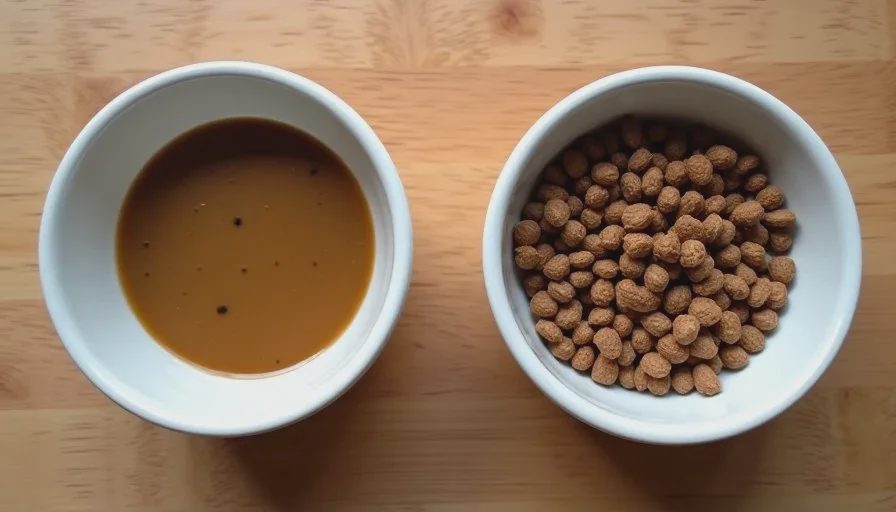
The clearest measurable difference between wet and dry food is moisture content. Wet food typically contains a much higher percentage of water. Dry food contains far less. For cats that drink very little from the bowl, the moisture in wet food can make a meaningful contribution to total daily water intake.
That does not mean dry-fed cats cannot stay well hydrated. Many do, especially when fresh water is easily available, multiple bowls are offered, or a fountain encourages drinking. It does mean that if your cat consistently produces concentrated urine, has a history of urinary concerns, or simply ignores the water bowl, increasing moisture through food is one of the more direct levers available.
I encouraged owners to notice their cat’s drinking habits before deciding that one format was required. Some cats drink readily. Others do not. Observation of litter box habits, urine volume if you can reasonably notice it, and overall energy often gives more useful information than a general rule.
Calories, Portions, and Weight Control
Dry food is more calorie-dense by volume. A cup of dry food generally delivers more energy than the same visual volume of wet food. This makes dry food easy to overfeed if portioning is based on the bowl looking “full” rather than on measured amounts and body condition.
Wet food’s higher moisture content means you are feeding more volume for fewer calories in many cases. Some owners find this helpful for cats that need to lose weight or that finish meals too quickly. Others find the larger volume less convenient for free-feeding or for multi-cat households with different needs.
Neither format is automatically better for weight. The deciding factors are total calories over the day, consistency of measurement, and regular body-condition checks. A cat can gain weight on wet food if portions are generous. A cat can maintain a lean weight on dry food if calories are controlled and activity is adequate.
Dental Claims and What They Actually Cover
Dry food is frequently marketed with dental benefits. The mechanical action of chewing kibble can help reduce plaque in some cats, and certain dental diets are formulated with specific textures or additives for that purpose. However, ordinary dry food is not a substitute for dental care. Many cats still develop significant dental disease while eating dry food exclusively.
Wet food does not clean teeth. That is a fair statement. It is also fair to say that dental health depends more on individual predisposition, age, professional cleanings when recommended, and home care than on food texture alone. Using dental claims as the sole reason to choose dry food—or as the sole reason to avoid wet food—overstates what the average bag or can delivers.
Convenience, Cost, and Real Household Schedules
Dry food wins on convenience for most working households. It can sit in a bowl longer without spoiling, supports measured free-feeding when appropriate, and is usually less expensive per calorie. Storage is simple. Travel is simpler.
Wet food requires more daily handling. Cans or pouches need refrigeration after opening. Portions must be managed more carefully to avoid waste. The cost per day is often higher. For owners who are home at meal times and who prefer the moisture benefit, these trade-offs are acceptable. For owners with unpredictable schedules or multiple cats with different preferences, they can become a source of ongoing friction.
I rarely saw long-term success with a feeding plan that constantly fought the household’s actual routine. A plan that is nutritionally reasonable and sustainable for the people involved usually outperforms a theoretically perfect plan that creates daily stress.
Palatability and Individual Preference
Cats can be strongly texture- and aroma-oriented. Some prefer the higher smell and softer texture of wet food. Others readily eat dry food and show little interest in cans. Forcing a format a cat consistently rejects rarely ends well. Appetite is information.
When a cat has a clear preference, working with that preference while still meeting nutritional and hydration goals is usually more practical than trying to override it completely. Some cats accept a mixed approach—wet food at certain meals and dry food at others—more readily than a total switch.
A Calm Way to Decide or Combine
Rather than treating the choice as permanent and absolute, consider a short list of practical filters:
How much does this cat voluntarily drink?
Is there any history of urinary or kidney concerns that makes moisture intake a higher priority?
What does the daily schedule realistically allow?
Is weight control currently a focus, and which format makes portioning easier for you?
Does the cat show a strong preference that affects intake?
If moisture is a priority and the schedule allows, wet food or a wet-food-inclusive plan is often worth the extra effort. If the cat drinks well, maintains good weight, and the household needs maximum simplicity, a complete dry food can be a reasonable foundation. Many households land in the middle: wet food once or twice a day and a controlled amount of dry food available or offered at other times.
When you change formats or ratios, transition gradually. Sudden switches are a common cause of digestive upset and temporary refusal. A week or longer of slow mixing gives most cats time to adjust.

What to Watch After You Choose
The label and the format are only the starting point. The real feedback comes from the cat. Over the following weeks, notice:
Appetite consistency
Body weight and condition
Energy and playfulness
Stool quality
Litter box patterns
Coat and skin condition
If those markers remain stable or improve, the current approach is doing its job for this animal. If weight creeps up, stool becomes inconsistent, or the cat begins leaving food, adjust one variable at a time rather than overhauling everything at once.
Common Sources of Pressure Worth Setting Aside
Online discussions sometimes frame dry food as inherently harmful or wet food as the only responsible choice. Neither framing matches the range of healthy cats I saw in practice. Complete and balanced dry foods support many cats well for years. Thoughtful wet-food feeding supports many others. The determining factors are the individual animal, the total diet, water access, and consistent monitoring—not the format alone.
Cost-shaming and convenience-shaming also appear more often than they should. A feeding plan that fits the household budget and schedule is more likely to stay consistent. Consistency matters more than matching the most idealized version of cat nutrition.
Bringing the Decision Back to Your Kitchen
Wet food and dry food each offer real practical strengths. Wet food contributes meaningful moisture and can help with calorie control for some cats. Dry food offers convenience, cost efficiency, and ease of measured feeding. Neither is universally superior. The better choice is the one that keeps your cat in good condition while remaining sustainable for the people who actually do the feeding.
You can start with one format, use a mix, or adjust over time as your cat’s needs and your schedule change. The calm approach is to decide based on hydration habits, weight trends, dental care realities, and daily logistics—not on the loudest claim in the aisle or the feed.
Let’s make this make sense. Look at the cat in front of you, the routine you can keep, and the results you can measure. That combination will take you further than any absolute rule about cans versus kibble.


From readers
Letters
No letters yet.
Be the first to write in. We read everything that arrives, and we answer most of it.