
Let’s make this make sense. One of the most common late-night worries I heard in the clinic was a version of this: “My dog has diarrhea but seems fine otherwise. Do I need to do something right now, or can I wait?” The question sounds simple. The feeling behind it is usually not. You are looking at soft or loose stool, your dog is still eating, still wagging, still interested in the usual routine, and yet the internet has a way of turning every change into an emergency.
I’m Claire Whitaker. For more than ten years I worked as a client educator in small-animal clinics around Minneapolis, helping owners sort through exactly these kinds of everyday digestive questions. My role was not to diagnose. It was to help people notice the right details, calm the immediate panic, and decide whether the situation could be monitored at home for a short time or whether a call to the veterinarian made more sense.
This post is the slower version of that conversation. We will walk through what “seems fine” actually includes, which details are worth writing down, how food changes and other ordinary factors often play a role, and a practical order for watching the next 24 to 48 hours.
What “Seems Fine” Really Means
When owners said their dog seemed fine, they usually meant a combination of things: the dog was still interested in food, still drinking, still moving around the house normally, still greeting people at the door, and not showing obvious signs of pain or lethargy. Those observations are useful. They are also incomplete if they stop there.
A dog can have soft stool and still appear energetic for a while. The more helpful approach is to treat “seems fine” as a starting checklist rather than a final verdict. Ask yourself a few quieter questions:
Is appetite the same as usual, or slightly reduced?
Is water intake normal, increased, or decreased?
Is energy consistent through the day, or are there dips?
Is the dog still interested in usual walks and play, or just going through the motions?
Are there any other changes—gas, gurgling sounds, scooting, or a hunched posture?
None of these single details decide the outcome on their own. Together they give you a clearer picture than stool consistency alone.
Soft Stool Versus True Diarrhea
People often use “diarrhea” for any stool that is softer than normal. In practice it helps to notice the difference between mildly soft stool that still holds some shape and watery stool that leaves little or no form. Frequency matters too. One soft stool after a rich treat is different from several loose stools in a short window.
I encouraged owners to make a quick mental or written note of three things: consistency, frequency, and any obvious trigger from the previous day. That simple habit turned many vague worries into clearer information they could later share with their veterinarian if needed.
Color can occasionally add useful context—especially if it is unusually dark, black, or contains visible red—but most everyday soft stool falls into a range of normal brown shades. The bigger priority for most households is tracking whether the pattern is improving, staying the same, or getting worse over the next day or two.
Common Everyday Triggers I Saw Repeatedly
In clinic conversations, a large share of short-term soft stool had ordinary explanations. A recent food change, even a gradual one, ranked high on the list. Many dogs need more time than owners expect to adjust to a new formula. Treats, table scraps, or a new chew can also shift digestion temporarily. Stress from guests, a boarding stay, a move, or even a change in the household routine sometimes showed up in the stool before it showed up in behavior.
Scavenging on walks—eating something unknown in the grass or from the ground—was another frequent factor. So was a sudden increase in rich protein or fat. None of these automatically mean a serious problem. They do mean that the first useful step is often to look backward at the previous 24 to 48 hours rather than only forward into worst-case scenarios.
If a food transition is underway, slowing the pace of the switch or temporarily simplifying the diet (under guidance you have already received from your veterinarian) was a common practical adjustment. If treats have been generous, reducing them for a few days often gave a clearer picture of whether the main food was the issue.
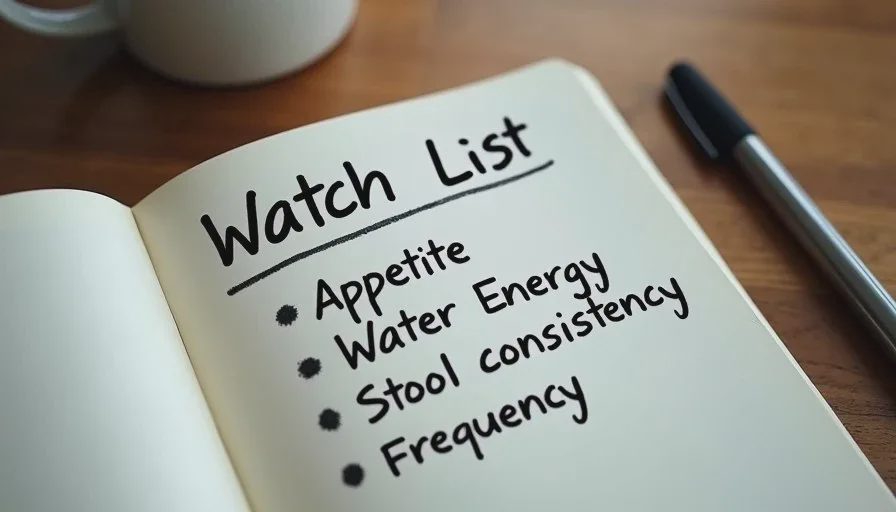
A Calm 24-to-48-Hour Watch List
When a dog had soft stool but still seemed generally well, I usually suggested a short period of focused observation rather than immediate intervention, provided there were no red-flag signs. The goal was not to ignore the change. It was to gather better information.
During that window, pay attention to:
Appetite at each meal
Water intake
Energy level morning, afternoon, and evening
Number of stools and their consistency
Any vomiting or repeated attempts to vomit
Any signs of discomfort such as restlessness, whining, or a tense abdomen
Writing these observations down in a simple note on your phone or a piece of paper on the fridge makes the pattern easier to see. Memory alone tends to flatten details, especially when you are worried.
If the stool begins to firm up and the dog continues to act like himself, many short-term episodes resolve with time and a bit of dietary simplicity. If the stool stays loose or becomes more frequent, or if any of the other checklist items start to slip, that is useful information for a call to your veterinary clinic.
When “Seems Fine” Stops Being Reassuring
There are situations where waiting is not the better first step. I always made sure owners left the conversation with a clear sense of the difference.
Contact your veterinarian more promptly if the dog is very young, very old, or has an existing health condition that already affects digestion or immunity. The same applies if there is repeated vomiting along with the diarrhea, if the dog becomes lethargic, if the abdomen seems painful or distended, if there is blood in the stool that is more than a mild streak, or if the dog stops eating or drinking.
Large-breed deep-chested dogs and very small dogs can sometimes move from “okay” to dehydrated more quickly than owners expect. When in doubt, a phone call to the clinic for triage advice is never an overreaction. The staff would rather help you decide than have you wait through rising worry.
This post is not a substitute for that professional input. It is a way to organize your observations so the conversation with the clinic is clearer and less driven by panic.
Food Changes and the Soft-Stool Window
One of the most frequent patterns I saw was soft stool appearing a few days into a food transition. Owners often assumed the new food was “wrong” and switched again, which sometimes extended the digestive upset. A slower transition—mixing increasing amounts of the new food over seven to ten days or longer for sensitive dogs—reduced the chance of this problem for many households.
If you are in the middle of a switch and soft stool appears while the dog otherwise seems well, it can be reasonable to hold at the current mixing ratio for an extra couple of days before progressing, or to step back slightly, provided your veterinarian has not given different instructions for your specific animal. The key is to change only one variable at a time so you can actually see what helps.

Practical Steps You Can Take at Home While You Watch
Keep the routine as steady as possible. Sudden new treats, new chews, or table food add variables you do not need while you are trying to understand the current stool pattern. Fresh water should always be available. Short, familiar walks are usually better than long new adventures if the dog’s energy is even slightly off.
Some owners found it helpful to temporarily feed smaller, more frequent meals rather than one or two large ones, simply to reduce the volume moving through the gut at once. This is a practical adjustment, not a cure. If you have previously been advised by your veterinarian to use a specific bland diet for short-term digestive rest, follow that guidance rather than inventing a new protocol from memory or from a quick online search.
Avoid reaching for over-the-counter products unless your veterinarian has already recommended a specific option for your dog. Many well-intentioned additions can complicate the picture.
The Emotional Side of Watching and Waiting
I want to name something that rarely appears in clinical handouts. Sitting with uncertainty is uncomfortable. Soft stool is visible evidence that something is different, and the desire to fix it immediately is understandable. The owners who managed these episodes with the least added stress were usually the ones who gave themselves a defined observation window and a clear list of what would trigger a call to the clinic.
You are not doing nothing when you watch carefully. You are collecting the information that makes the next decision better. That is a form of care.
Bringing the Details Together
When your dog has diarrhea but still seems fine, the most useful first move is rarely a dramatic change. It is a short period of structured noticing: appetite, thirst, energy, stool frequency and consistency, and any other shifts in comfort. Look backward for ordinary triggers such as food changes, treats, scavenging, or stress. Keep the current routine simple. Know in advance which signs would make you pick up the phone sooner.
Most short-term soft stool episodes in otherwise well dogs improve with time and a bit of simplicity. Some do not. The difference becomes clearer when you have actual observations instead of rising worry.
You know your dog’s normal better than any article can. Use that knowledge. Write down what you see. And if the picture starts to drift from “seems fine,” let the clinic help you interpret it.
Let’s make this make sense, one calm observation at a time.



From readers
Letters
No letters yet.
Be the first to write in. We read everything that arrives, and we answer most of it.