
Let’s make this make sense. After more than ten years of sitting with dog and cat owners in small-animal clinics around Minneapolis, one feeding pattern showed up more often than any other. It was not dramatic. It rarely looked like neglect. In fact, it usually came from people who were trying hard to do the right thing. The mistake was simple on the surface and surprisingly costly over time: changing too many things at once, or changing the main food too quickly, without enough observation in between.
I’m Claire Whitaker. My role in the clinic was client education focused on nutrition and everyday care. I was the person owners talked to after the veterinarian had outlined a plan, or the person they called when a new food, a new treat, or a new supplement had produced unexpected results. The conversations were rarely about rare diseases. They were about ordinary households trying to interpret ordinary changes.
This post is about the pattern I saw most consistently, why it created so much secondary stress, and a steadier way to approach feeding decisions so the next change is easier to read.
What the Mistake Actually Looked Like
The most common version went like this. A dog or cat had soft stool, a period of lower appetite, a duller coat, or gradual weight gain. The owner, wanting to help, switched the main food. At the same time they added a new treat, a digestive supplement, or a different feeding schedule. Sometimes they also changed the amount significantly because the new bag suggested a different cup measurement. Within days the stool was still off, or the animal was refusing the new food, or a new issue had appeared. Now there were four variables and no clear way to know which one mattered.
Another frequent version involved free-feeding dry food while adding generous wet food “toppers” or table scraps, then feeling confused when weight crept up or stool quality declined. The intention was kindness. The result was a calorie and ingredient picture that no longer matched what the owner thought was being fed.
A third version appeared during well-intentioned transitions. An owner would move from one food to another over two or three days because the bag or a quick online tip suggested that was enough. For many dogs and cats it was not. Digestive upset followed, the new food was blamed, and another switch was made. The animal never had a stable baseline long enough for anyone to evaluate the diet fairly.
None of these patterns meant the owner was careless. They meant the feedback loop between change and observation had been shortened or overloaded.
Why This Pattern Created So Much Extra Worry
When several things change at the same time, the animal’s response becomes difficult to interpret. Soft stool could be the new protein, the speed of the transition, the extra treats, or a coincidence with something scavenged on a walk. Low appetite could be flavor preference, an abrupt texture change, or an unrelated mild illness. The owner is left guessing, and guessing under worry tends to produce more changes rather than fewer.
I watched this cycle repeatedly. Each new adjustment was meant to solve the last problem. Each one added another layer of uncertainty. By the time the owner sat down with me, they were often exhausted and convinced they had somehow failed at a basic task.
The emotional cost was real. Feeding is one of the most frequent daily interactions people have with their animals. When that interaction becomes a source of ongoing second-guessing, the whole relationship feels less steady.
The Clinic Conversation That Usually Helped
When someone described a recent cascade of changes, I rarely started with a new product recommendation. I started by reconstructing the timeline. What was the original concern? What was changed first? How many days passed before the next change? What was the animal’s stool, appetite, and energy doing between steps?
Most of the time the timeline itself revealed the problem. There had not been enough stable days to evaluate any single decision. The most useful next step was often to simplify: return to one clear main food, reduce extras to a minimum, and watch for several days before judging the result.
This approach felt almost too plain to some owners. They had arrived ready for a more sophisticated answer. Yet the plain version usually produced clearer information faster than another round of layered adjustments.
A Steadier Way to Make Feeding Changes
The practical alternative is not complicated. It rests on three habits.
First, change one major variable at a time. If you are switching the main food, hold treats, toppers, and supplements steady during the transition. If you are testing a new treat, keep the main food the same. This is less exciting than a full refresh, but it makes the animal’s response readable.
Second, give the change enough time to show a pattern. For a food transition, many dogs and cats do better with seven to ten days of gradual mixing, and some sensitive animals need longer. After the transition is complete, another week or two of consistent feeding often gives a fairer picture of stool quality, appetite, and energy than judging on day three.
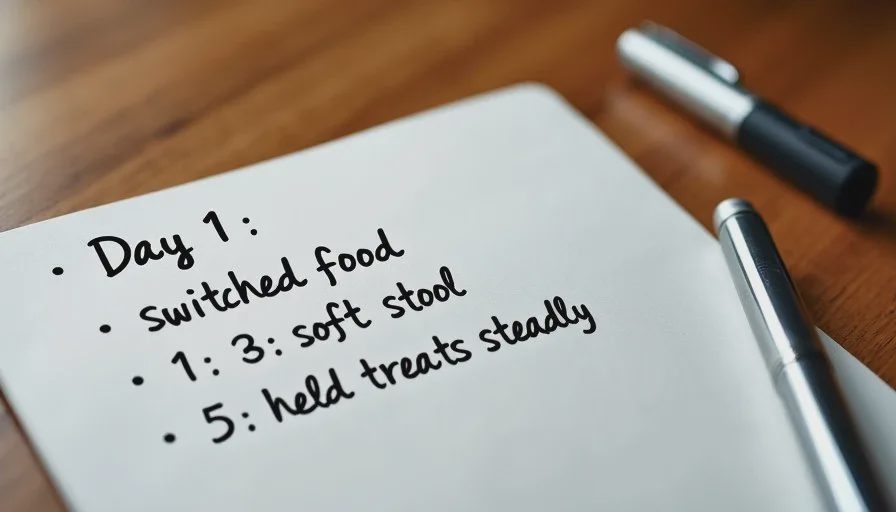
Third, write down the basics. A simple note with dates, stool observations, appetite, and any extras offered prevents memory from smoothing over the details. When you later need to talk with your veterinarian, the notes turn a vague story into useful information.
These habits do not eliminate every digestive hiccup. They do reduce the secondary confusion that comes from not knowing what caused it.
Why Speed Feels So Tempting
There is a reason owners change things quickly. Soft stool is visible. A refused meal is visible. Online advice is immediate. The desire to fix the problem before the next walk or the next morning is understandable. Waiting feels like doing nothing.
In reality, structured watching is not doing nothing. It is collecting the evidence that makes the next decision better. The owners who adopted this slower rhythm usually ended up making fewer total changes and feeling less reactive when minor variations appeared.
I also noticed that speed was often driven by guilt. The thought process went something like: “If I were a better owner, I would have already fixed this.” That thought pushes action for its own sake. A calmer frame is: “I am gathering enough information to choose the next step wisely.” Both come from care. Only one tends to reduce the total stress.

Related Patterns That Sat Next to the Main Mistake
A few neighboring habits made the core problem worse.
Treating the feeding guideline on the bag as a fixed requirement rather than a starting point. Bags offer averages. Individual dogs and cats vary by age, activity, metabolism, and whether treats are part of the day. Adjusting portions based on body condition over time is more accurate than obeying the printed cup amount without question.
Using multiple new treats or chews as the primary way to show affection while the main diet was already adequate. Affection is important. It does not have to arrive primarily through calories.
Assuming that a more expensive or more trendy food would automatically resolve a problem created by an abrupt previous switch. Sometimes a different formula is genuinely better for an individual animal. Sometimes the previous formula would have worked fine if it had been introduced more slowly and given a fair trial.
What I Wanted Owners to Leave With
By the end of these conversations I hoped people would take away a simpler standard: make the smallest change that still addresses the concern, then watch long enough to learn something. That standard is less dramatic than a complete dietary overhaul. It is also more sustainable and far easier on both the animal and the person doing the feeding.
Feeding decisions will still arise. Puppies become adults. Adults become seniors. Preferences shift. Health needs change. The goal is not to avoid all future adjustments. The goal is to make each adjustment interpretable so you are not constantly restarting the puzzle from zero.
Bringing It Back to the Daily Routine
The feeding mistake I saw most often was not a single wrong food or a single wrong product. It was the habit of changing several things close together and then struggling to read the result. The correction is correspondingly straightforward: slow the rate of change, reduce the number of simultaneous variables, and give observation enough room to work.
You already care enough to notice when something is off. That attention is the most valuable tool you have. Pair it with a little more patience between steps, and most everyday feeding problems become clearer and less emotionally expensive.
Let’s make this make sense. The next time a change feels urgent, ask what single variable you can adjust and how many days you will watch before judging it. That small pause is often the difference between a short experiment and a long cycle of confusion.



From readers
Letters
No letters yet.
Be the first to write in. We read everything that arrives, and we answer most of it.