
Let’s make this make sense. Pet food packaging is designed to create trust quickly. Certain words appear so often that they start to feel like evidence of quality. In more than ten years of clinic conversations around Minneapolis, I watched owners reach for those words as shortcuts—only to end up more confused when the food did not perform as the language promised.
I’m Claire Whitaker. My work as a client educator focused on helping people translate labels and marketing into practical decisions. I never told anyone to ignore packaging entirely. I did encourage them to slow down when specific phrases appeared, because those phrases often carried less precise meaning than they seemed to.
This post looks at three of the most common ones I learned not to trust at first glance, why they create false confidence, and the quieter questions that lead to better choices.
Phrase One: “Natural”
“Natural” is one of the most frequently used and least precise terms on pet food packaging. Under AAFCO guidelines it has a defined meaning related to how ingredients are sourced and processed, but that definition is narrower than most owners assume. It does not automatically mean the food is minimally processed in every sense, free from every additive an individual animal might react to, or superior in digestibility or nutrient balance.
In clinic conversations, “natural” often functioned as a feeling rather than a fact. Owners would hold up a bag and say, “It’s natural, so it should be better for his stomach,” or “I switched to natural because I didn’t want artificial ingredients.” Sometimes the new food worked well. Sometimes it produced the same soft stool or the same refusal as the previous option. The word itself had not predicted the outcome.
The practical problem is that “natural” invites a moral comparison. Food that carries the word feels responsible. Food that does not can feel compromised. That emotional frame makes it harder to evaluate the actual formula—ingredient order, guaranteed analysis, nutritional adequacy statement, and the animal’s response over time.
When I saw the word, I trained myself to ask: What specific ingredients or processes am I hoping to avoid, and does this formula actually address them? That question is more useful than accepting the claim at face value.
Phrase Two: “Holistic”
“Holistic” has no official regulatory definition in pet food labeling in the same way some other terms do. It is largely a marketing word. It suggests a complete, balanced, whole-body approach, which sounds appealing. In practice it tells you almost nothing concrete about ingredient quality, nutrient levels, manufacturing standards, or suitability for a particular dog or cat.
I saw “holistic” used on formulas that varied widely in protein sources, carbohydrate content, and price. The word traveled with the product more than any consistent set of standards. Owners who relied on it as a quality filter often felt disappointed when the food did not resolve the issue that prompted the switch—whether that was itching, soft stool, or low energy.
The risk is not that every food labeled holistic is poor. The risk is that the word substitutes for scrutiny. A calm response is to treat “holistic” as decorative language and move immediately to the parts of the label that carry more information: the ingredient list, the guaranteed analysis, the life-stage statement, and any feeding trial or formulation claims that can be verified.
If a company wants to communicate a whole-animal philosophy, that can be explored through their broader materials. On the bag itself, the word rarely earns the trust it requests.
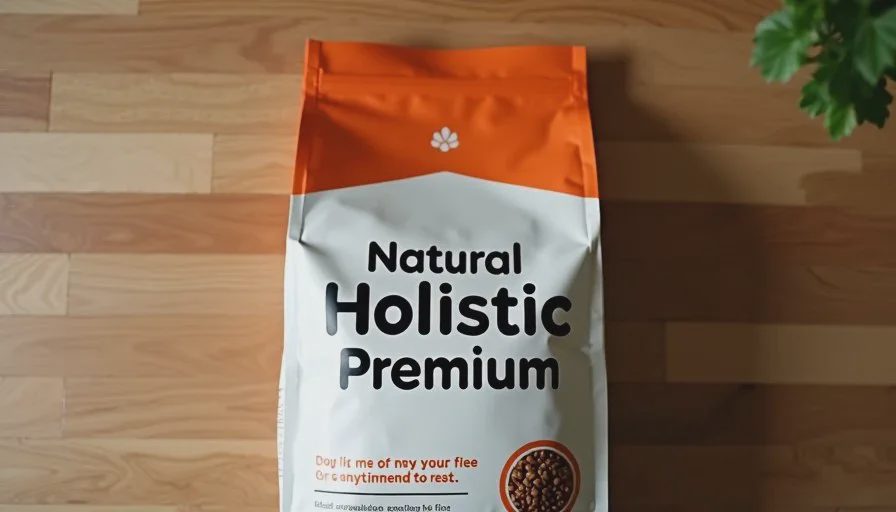
Phrase Three: “Premium” (and Its Close Relatives)
“Premium,” “super-premium,” “ultra-premium,” and similar escalations appear across price points and formulas. Like “holistic,” these terms lack a strict, enforceable definition tied to specific nutritional outcomes. They signal positioning more than they guarantee performance.
In the clinic I noticed that “premium” often correlated with higher price and more sophisticated packaging, which is expected. It did not consistently correlate with better stool quality, better coat condition, or better weight maintenance for the individual animals in front of me. Some expensive foods performed well. Some mid-priced foods performed equally well. Some high-priced foods produced the same digestive inconsistencies as cheaper options when the transition was rushed or the portions were wrong.
The emotional pull of “premium” is strong because it suggests you are giving your animal the best available. Questioning the term can feel like settling for less. A more accurate frame is that price and positioning are information about the market, not a direct report card on how the food will suit your dog or cat. The report card comes from the animal’s condition over weeks and months, and from the concrete details on the label.
When I saw “premium,” I asked what specific feature—protein source, inclusion of certain fats, absence of a particular ingredient, manufacturing transparency—was actually driving the choice. That shifted the conversation from status language to practical criteria.
Why These Phrases Persist
Marketing language exists because it works. Busy owners want signals that reduce decision time. Words like natural, holistic, and premium supply those signals efficiently. Regulatory frameworks allow them within defined or undefined boundaries. The result is packaging that feels informative while remaining carefully non-specific.
None of this requires assuming bad faith. It does require recognizing the gap between emotional reassurance and measurable information. The owners who struggled most with feeding decisions were often those who had moved from bag to bag following these words, each time hoping the next claim would finally match their animal’s needs. The pattern created expense, digestive disruption, and rising self-doubt.
A Quieter Set of Questions
Instead of stopping at the prominent claims, I encouraged a short sequence of more grounded questions:
Is the food complete and balanced for the correct species and life stage?
What are the primary ingredients by weight, and do they match what I think I am buying?
Does the guaranteed analysis make sense for my animal’s current needs?
Has this company published feeding trial data or clear formulation standards?
Most importantly: how is my dog or cat actually doing on the current diet—weight, stool, energy, coat, appetite?
These questions do not eliminate every uncertainty. They keep the decision attached to verifiable details and observed results rather than to the loudest words on the front of the bag.

What Trust Looks Like Instead
Trust in a pet food is built more slowly than marketing language suggests. It comes from consistent performance in the animal you live with, from transparent information when you go looking for it, and from a willingness to adjust when the evidence in the bowl and in the litter box or yard says something is off.
I never asked owners to become cynical. Cynicism is just another form of absolute thinking. I asked them to become slower—to let the prominent phrases register, then to move past them toward the information that actually supports a decision.
Some foods that use these words are solid choices. Some foods that avoid them are also solid choices. The words themselves are weak predictors. The animal’s response over time is a stronger one.
Bringing the Skepticism Back to the Aisle
The next time you pick up a bag or can and see “natural,” “holistic,” or “premium,” you do not need to reject the product automatically. You only need to resist treating the word as proof. Flip the package. Read the quieter lines. Consider the individual dog or cat waiting at home. And give any change enough time and enough control of other variables to produce readable results.
Feeding decisions will always carry some uncertainty. Marketing language tries to erase that uncertainty with confidence. The more durable approach is to accept a manageable amount of uncertainty and to reduce it through observation rather than through claims.
Let’s make this make sense. The phrases that sound most reassuring are often the ones that deserve the most deliberate pause. Use the pause. Your dog or cat will give you clearer feedback than the front of the bag ever can.


From readers
Letters
No letters yet.
Be the first to write in. We read everything that arrives, and we answer most of it.